
How to Style a Coffee Table Without Making It Look Cluttered
A coffee table is one of the easiest places to make a room feel finished—and one of the easiest places to add too much.
The goal isn't to fill every inch of the surface. It's to create a small composition that feels collected, personal, and effortless while still leaving room for everyday life.
At Fern & Home, we believe the most beautiful spaces aren't necessarily the ones with the most objects. They're the ones where each piece feels intentional.
Here's our simple approach to styling a coffee table with the right balance of shape, scale, texture, and breathing room.
Start With a Clear Surface
Before styling your coffee table, take everything off.
Starting with an empty surface makes it much easier to see what the room actually needs. You may discover that you need less than you thought.
Look at the coffee table in relation to the entire room rather than treating it as an isolated display.
Consider:
What does the room already have going on?
Is there artwork nearby that introduces a strong color?
Are there already several tall objects in the space?
Does the coffee table need warmth, texture, or contrast?
How much space do you need for everyday use?
A beautifully styled coffee table should complement the room—not compete with it.
Choose One Anchor Piece
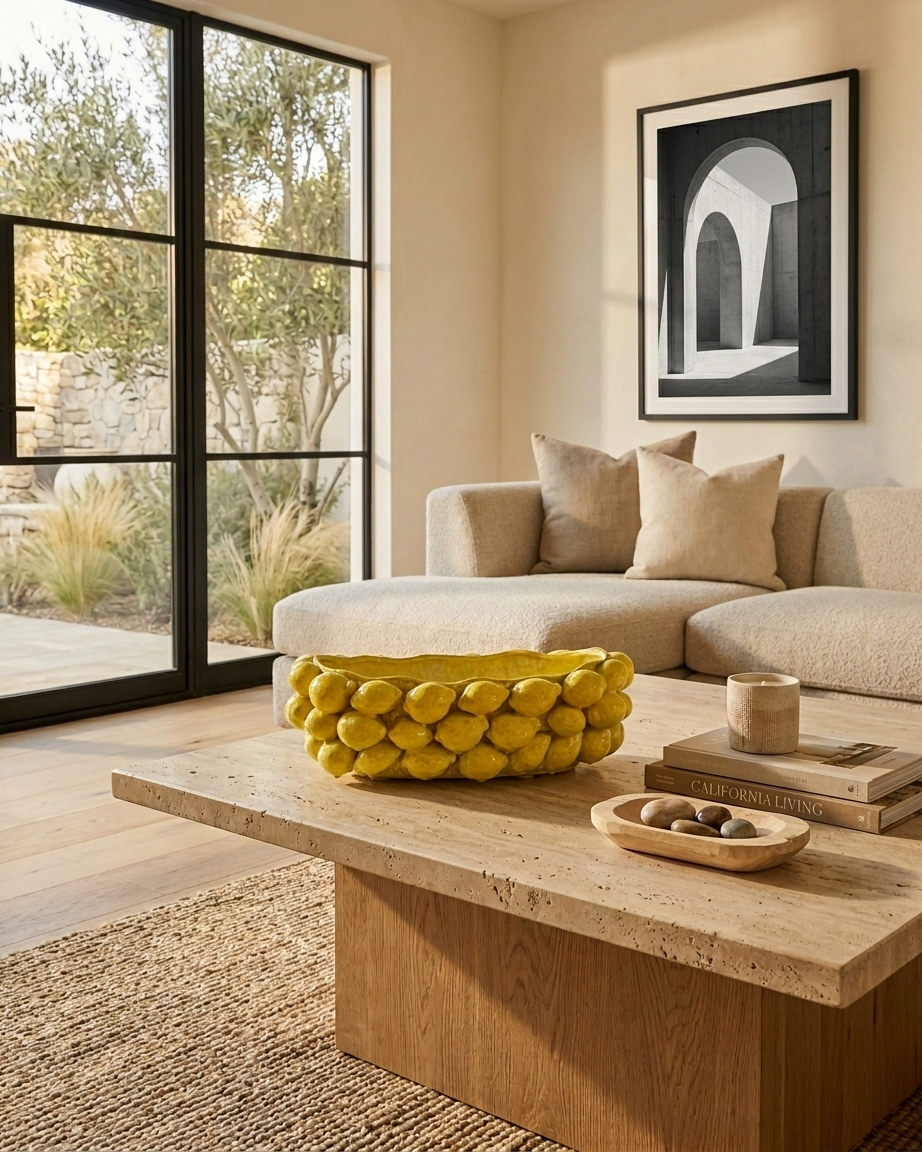
The easiest way to create a cohesive arrangement is to start with one substantial piece.
This could be:
A sculptural bowl
A statement vase
A decorative tray
A substantial object
A stack of beautiful books
Think of this as the visual anchor for everything else.
If you're using a large decorative bowl, for example, you don't necessarily need several other large objects around it. Let it have the moment.
This is one of our favorite Fern & Home styling principles:
Let one piece have the moment.
Everything around it should support—not compete with—it.
Build Around Three Elements
Once you've chosen your anchor, try thinking in terms of three layers:
Anchor + Layer + Detail
For example:
Sculptural bowl + coffee table books + small object
or:
Decorative tray + vase + candle
or:
Books + bowl + natural element
The three elements don't have to be identical in size or shape. In fact, contrast is what keeps the arrangement interesting.
The important thing is that they have a visual relationship.
Vary the Height
One of the easiest ways to make a coffee table arrangement feel flat is to use objects that are all the same height.
Instead, create a gentle rhythm of high, medium, and low.
A vase or sculptural object can provide height. Books create a lower layer. A small bowl or decorative object can fill the space between them.
You don't need to buy something specifically for every height.
Books are particularly useful because they can raise an object while adding another layer of texture and personality.
The result should feel layered rather than stacked.
Use a Tray to Create Structure
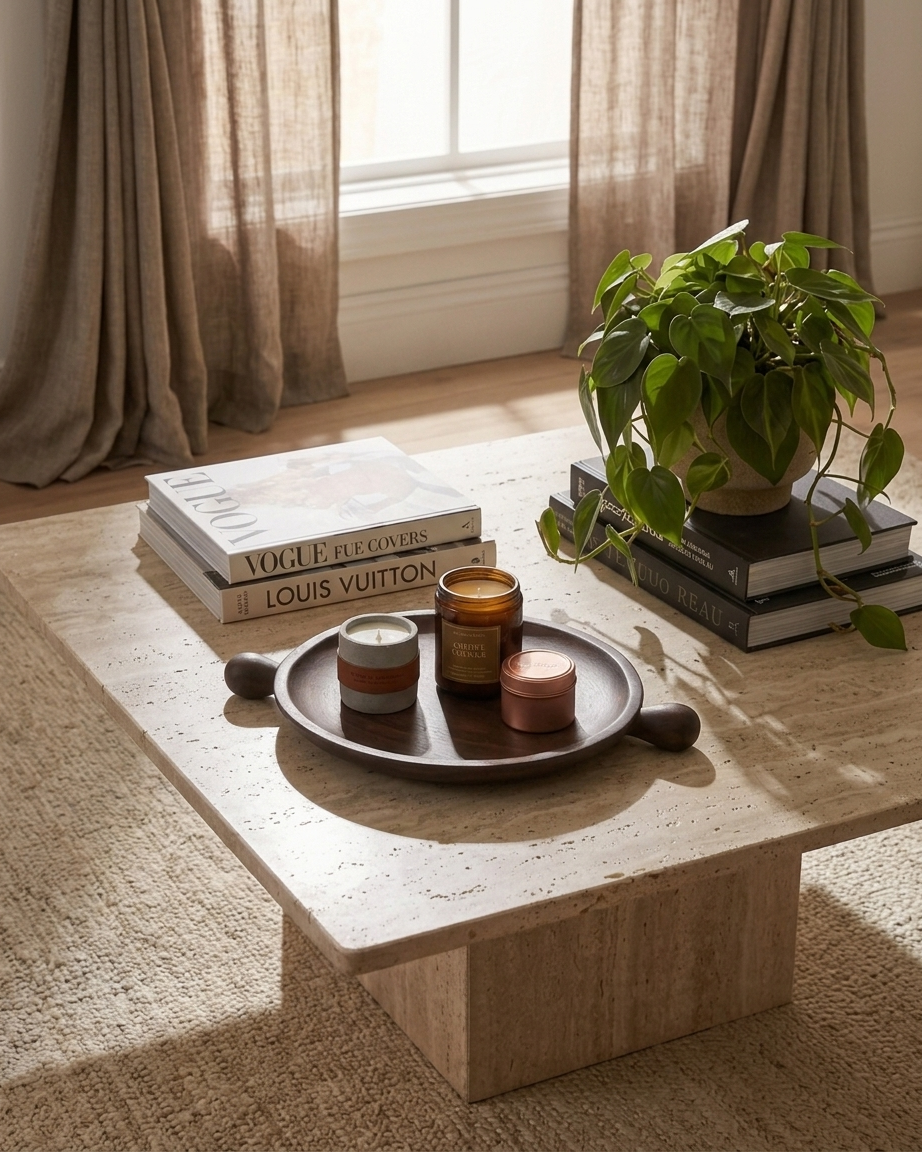
A tray is one of the most useful pieces for coffee table styling because it creates a visual boundary.
Instead of having several small objects scattered across the table, a tray gives them a natural home.
Try styling a tray with:
A small vase
A candle
A decorative object
A few books
A small bowl
A tray also has a practical advantage: when you need the coffee table cleared, you can move several objects at once.
For everyday living, that's a small detail that makes beautiful styling much easier to maintain.
If your coffee table is particularly large, you don't necessarily need one enormous arrangement. A tray can create one defined zone while leaving the rest of the surface open.
Don't Underestimate the Decorative Bowl
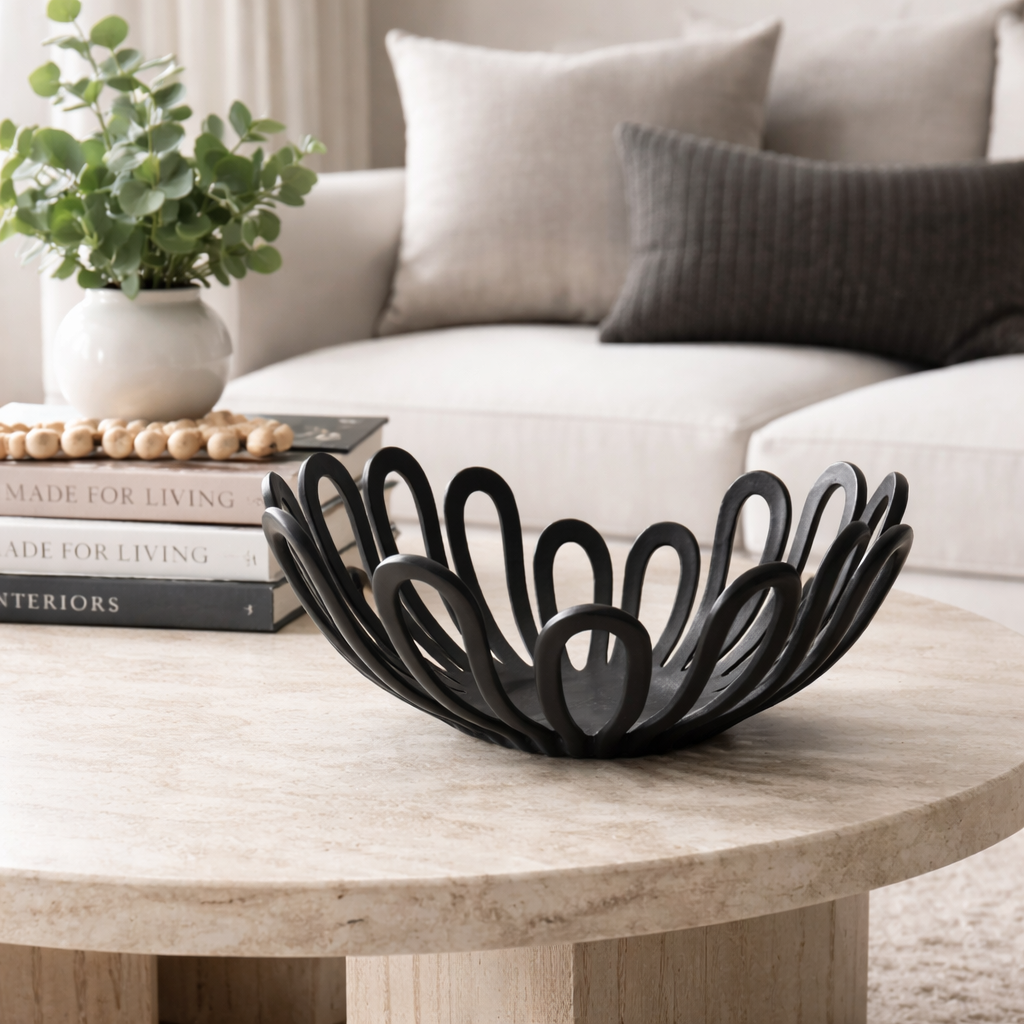
A decorative bowl can be one of the most effective pieces on a coffee table.
It brings a rounded, sculptural shape to an otherwise flat surface and can work beautifully whether it's filled or completely empty.
Try a bowl with:
Nothing inside for a minimalist look
Decorative beads or spheres
Seasonal elements
Dried botanicals
A few natural objects
The bowl doesn't need to be perfectly centered, either.
On a rectangular table, placing a bowl slightly off-center can create a more relaxed, collected feeling.
For more ideas on using decorative bowls throughout the home, see our guide to the best places to put a decorative bowl in your house.
Add Color—But Don't Match Everything
A coffee table is a great place to connect the colors already present in your room.
Look around before choosing your accessories.
Perhaps your artwork has a warm terracotta detail. You could echo that color in a ceramic vase.
Maybe your room has deep wood tones. A wooden tray or sculptural object can reinforce that warmth.
Or perhaps the room is mostly neutral and could benefit from one unexpected color.
The goal isn't to make everything match.
It's to create subtle connections between pieces.
This is the same approach we use when styling open shelves: repeat a color or material here and there rather than trying to coordinate every object.
Mix Shapes and Textures
Good coffee table styling isn't about buying objects from the same collection.
It's about contrast.
Try combining:
Ceramic + wood
Glass + stone
Smooth + textured
Organic + architectural
Round + angular
A sculptural ceramic bowl can soften a rectangular stack of books. A glass vase can add lightness next to a heavier wooden tray.
These contrasts give the arrangement depth without requiring more objects.
Bring in Something Living
A little greenery can completely change a coffee table arrangement.
You don't need a large bouquet.
A few branches in a sculptural vase, a single stem, or a small plant can introduce movement and soften the harder edges of books, trays, and decorative objects.
And don't feel that greenery needs to be symmetrical or perfectly arranged.
A slightly imperfect branch often feels much more natural.
Style According to the Shape of Your Coffee Table
The shape of the table should influence how you arrange your objects.
Round Coffee Table
A round table naturally lends itself to one central composition.
Try:
Bowl + books + small object
or a single substantial centerpiece surrounded by negative space.
Avoid creating too many separate zones, which can make a round surface feel busy.
Rectangular Coffee Table
A rectangular table gives you more room to create two or three visual zones.
For example:
Tray on one side
Books + bowl toward the center
Small object or vase on the other side
Just make sure the arrangement still feels connected.
Square Coffee Table
A square table can tempt you to decorate every corner.
Don't.
Instead, create one strong composition—or two related groupings—and allow some corners to remain empty.
Glass Coffee Table
With a glass table, less is usually more.
Because the surface already creates visual lightness, choose a few pieces with interesting silhouettes rather than filling the table with small accessories.
Remember the Rule of Negative Space
This may be the most important coffee table styling rule of all.
Leave some space empty.
Negative space gives the eye somewhere to rest. It also makes the pieces you've chosen feel more important.
A coffee table should still be usable.
There should be somewhere to put down a glass, set down a book, or simply rest your feet without navigating an obstacle course of decorative objects.
If your arrangement feels slightly too busy, remove one thing.
Then look again.
You may find that it was the missing space—not another object—that the arrangement needed.
Don't Forget How You Actually Live
The most beautiful coffee table in a photograph isn't necessarily the right coffee table for your home.
If you regularly entertain, leave enough space for drinks.
If you have young children, avoid fragile or sharp objects at the edges.
If your coffee table doubles as a place to work, choose pieces that can be moved easily.
And if you simply prefer a very uncluttered room, you may only need one beautiful object.
Intentional decorating isn't about following a formula perfectly.
It's about creating a home that works beautifully for the life happening inside it.
The Fern & Home Coffee Table Formula
If you're not sure where to begin, try this:
1. Start with one anchor.
Choose a substantial bowl, vase, tray, or object.
2. Add a lower layer.
Use books to create height and visual interest.
3. Introduce a contrasting shape.
Pair rounded forms with something more architectural.
4. Repeat a color or material.
Look for a subtle connection with artwork or furnishings nearby.
5. Add one natural element.
A branch, stem, or small piece of greenery brings movement.
6. Leave room to live.
Don't fill the entire surface.
7. Remove one thing.
If you're unsure, take one piece away and see how the arrangement feels.
The last step is often the one that makes the biggest difference.
A Beautiful Coffee Table Doesn't Need to Look Decorated
The best coffee table arrangements don't necessarily announce themselves as "styled."
They feel as though they've evolved naturally over time—a favorite book, a sculptural bowl, a vase picked up because you loved its shape, a tray that happens to make everyday life easier.
That's the balance we look for at Fern & Home.
Fewer, better pieces. More character. More room to live.
A beautiful home isn't created by filling every surface.
Sometimes, the most sophisticated thing you can add is a little space.
Explore Fern & Home
Discover thoughtfully curated vases, bowls, trays, artwork, and decorative objects designed to bring character, color, and effortless style home.
